
Why Story Structure Matters for YouTube
Every great movie, book, and TV show follows a story structure. YouTube videos are no different. The creators with the highest retention rates aren't just good on camera, they're good storytellers, and a deliberate YouTube story structure is what separates a video people finish from one they abandon at the two-minute mark.
Story structure gives your video a sense of momentum. Viewers feel like they're going somewhere, and that momentum keeps them watching.
The Three-Act Structure for YouTube
Act 1: The Setup (First 15% of your video)
Goal: Hook the viewer and establish the premise.
- Open with a strong hook (curiosity, bold claim, or relatable problem)
- Briefly establish what the video is about
- Tell the viewer what they'll gain by watching
- Create an open loop, tease something that comes later
Example: "I lost 10,000 subscribers in one month because of a mistake I didn't even know I was making. And I'm going to show you exactly what it was so you never make the same mistake."
Act 2: The Journey (Middle 70%)
Goal: Deliver the core value with rising tension.
This is where your main content lives. Structure it as a journey with:
- Escalating value: Start with good tips and build to your best
- Mini-hooks: Tease upcoming sections to maintain curiosity
- Pattern interrupts: Change the visual or auditory rhythm every 60–90 seconds
- Conflict and resolution: Present problems before solutions
Key principle: Each section should feel like it's building toward something bigger. If your middle section feels like a flat list, add narrative connectors: "But here's where it gets interesting..." or "Now this next part is what really changed everything for me."
Act 3: The Payoff (Final 15%)
Goal: Deliver the climax and close strong.
- Deliver your biggest insight or reveal
- Summarize key takeaways
- Emotional close, connect the content to something bigger
- Call to action (subscribe, comment, watch the next video)
Don't just stop. Give viewers a sense of completion and direction for what to do next.
Story Structures That Work on YouTube
The Problem-Solution Arc
Setup: Present a relatable problem → Journey: Explore why it happens → Payoff: Reveal the solution
The Transformation Arc
Setup: Show the "before" state → Journey: Walk through the process → Payoff: Reveal the "after" result
The Countdown Arc
Setup: Tease the best item → Journey: Count down from least to most impactful → Payoff: Reveal #1
The Mystery Arc
Setup: Present a question or puzzle → Journey: Investigate clues → Payoff: Reveal the answer
Common Storytelling Mistakes
- No hook: Starting with a greeting instead of a curiosity trigger
- Flat middle: A list without narrative momentum
- Weak ending: Trailing off instead of delivering a satisfying payoff
- Too much setup: Spending 2 minutes before getting to the value
- No emotional stakes: All logic, no feeling
How to Apply YouTube Story Structure to Any Video
Frameworks are useless if you can't apply them under deadline, so here is a fast way to impose a YouTube story structure on any idea in about five minutes, before you write a single line of script.
- Name the payoff first. Decide the one thing the viewer will know, feel, or be able to do by the end. Everything in your YouTube story structure exists to make that payoff land, if a section doesn't build toward it, cut it.
- Pick an arc that fits the payoff. A tutorial wants the transformation arc; a "best of" wants the countdown; a case study wants problem-solution. Matching arc to payoff is 80% of a good YouTube story structure.
- Plant one open loop in the first 30 seconds. Promise something you'll only resolve later. That single unresolved question does more for retention than any amount of editing polish.
- Map the middle as escalation, not a list. Order your points weakest to strongest so the video feels like it's climbing. A flat middle is where most videos lose the plot, and the audience.
- Close the loop, then point forward. Deliver the promised payoff, then give one clear next step. A satisfying ending is what earns the next click, and YouTube's systems reward sessions, not just single videos.
Do this once and it feels mechanical; do it ten times and YouTube story structure becomes instinct. You'll start seeing the arc in your idea before you ever open a document, which is exactly when planning stops slowing you down and starts multiplying your retention.
One caution: structure serves the story, not the other way around. If you force a countdown onto content that's really a transformation, viewers feel the seams even if they can't name why. The goal of a good YouTube story structure isn't to make every video formulaic, it's to give each idea the shape that lets it land hardest. Once the arc is doing its job invisibly, the audience never notices the scaffolding, they just feel that the video "flows" and, almost without deciding to, watch it to the end. That invisible momentum is the whole point: viewers can't tell you why they stayed, only that they did, and that is exactly the feeling a deliberate structure is engineered to produce.
How Creator AI Helps With Story Structure
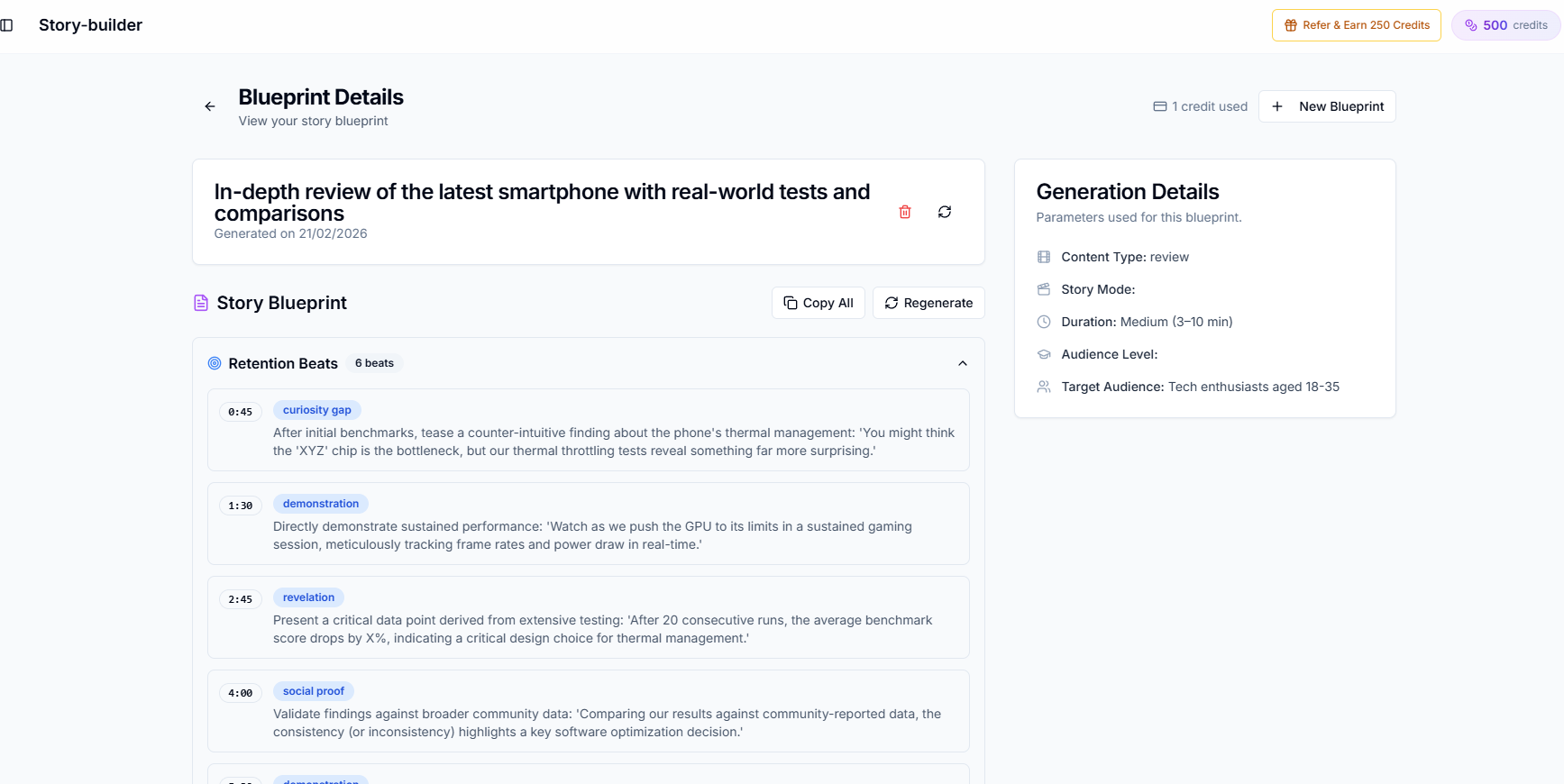
Creator AI's story blueprint feature helps you plan your video's narrative arc before you write a word:
- Choose from proven story structures
- Get a section-by-section outline tailored to your topic
- Each section includes timing guides and transition suggestions
- Integrates directly with script generation
Great videos start with great plans. Creator AI helps you build the plan, then build the script that brings it to life.
Keep Reading
- How to Write YouTube Scripts That Get More Views
- How to Find Trending YouTube Video Topics (Step-by-Step)
- Plan your next video with the Story Builder, get started free.
- Learn storytelling fundamentals at YouTube Creators.
Frequently Asked Questions
What is the best story structure for YouTube videos?
Proven arcs include problem-solution, transformation, countdown, and mystery. Each opens with a hook and an open loop, builds with escalating value, and ends on a satisfying payoff.
What is the three-act structure for YouTube?
Act 1 (first 15%) hooks the viewer and sets the premise, Act 2 (middle 70%) delivers escalating value with mini-hooks and pattern interrupts, and Act 3 (final 15%) lands the payoff and CTA.
How do open loops improve retention?
An open loop teases something coming later, like 'tip #5 changed everything', creating curiosity that keeps viewers watching until you deliver the payoff.