
The AI Shift in YouTube Content (2026)
Two years ago, using AI for YouTube felt experimental. In 2026, AI content creation is becoming table stakes. Creators who leverage AI for scripting, thumbnails, and research are publishing faster, staying consistent, and growing channels that still sound like them.
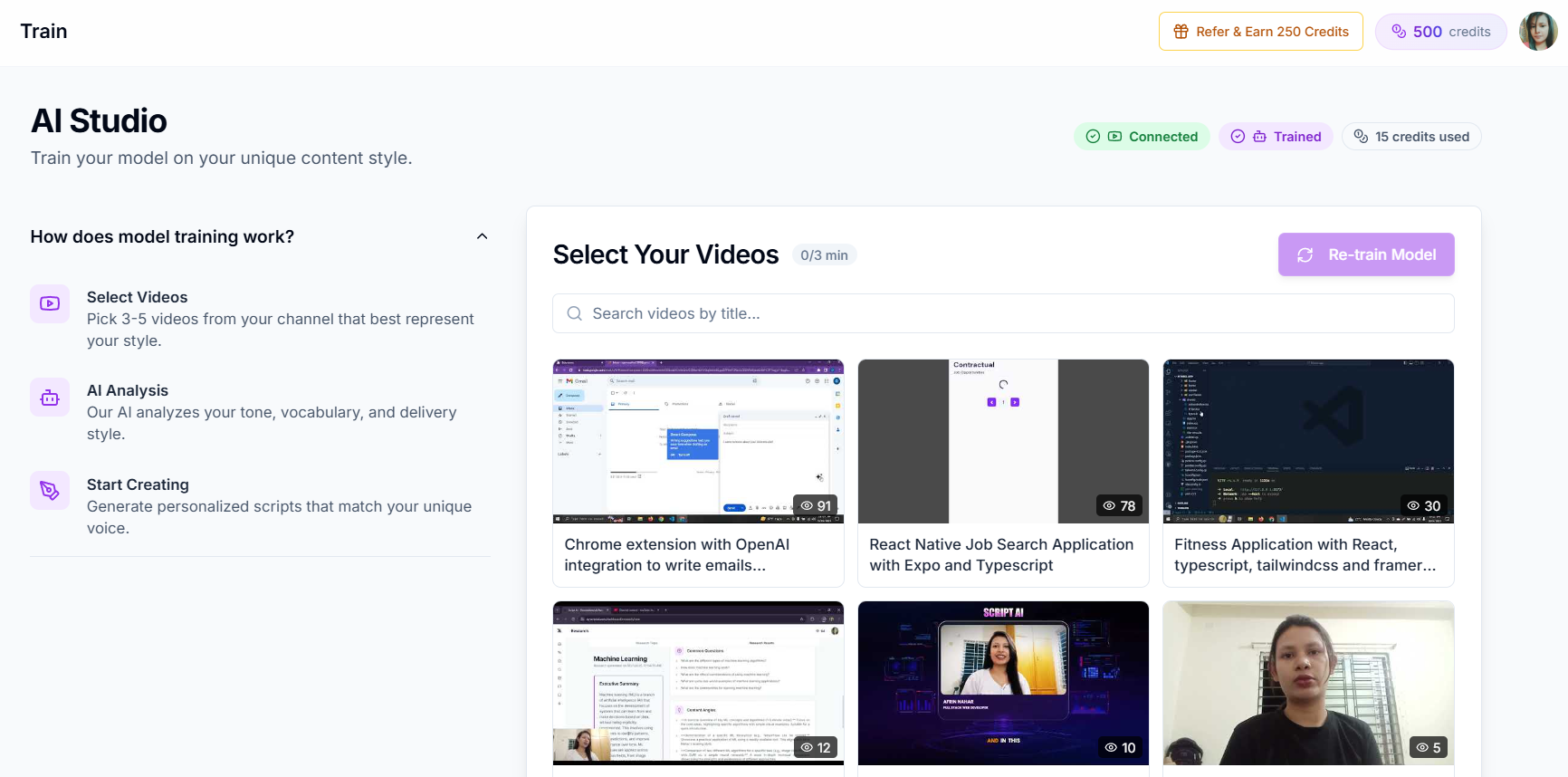
But AI for creators isn't just about ChatGPT. The tools that matter most in 2026 are the ones built specifically for the YouTube workflow, not general-purpose chatbots stretched across five tabs.
YouTube reports that upload volume and format diversity on the platform continue to climb year over year, and creators who adopt AI for scripting and production are among those publishing most consistently without burning out.
Where AI Is Making the Biggest Impact
1. Script Writing
This is the most obvious application. AI can generate full scripts from a brief topic description. But the quality varies wildly depending on the tool:
- Generic AI tools produce usable but impersonal scripts
- Creator-specific AI (like Creator AI) generates scripts that match your voice and are optimized for YouTube retention
The key differentiator is personalization. Viewers can tell when a script doesn't sound like you.
2. Thumbnail Generation
AI thumbnail tools are getting remarkably good. They can generate compelling, click-worthy thumbnails in seconds, something that used to require design skills and 30–60 minutes in Photoshop.
3. Subtitle and Translation
AI-powered transcription has reached near-human accuracy. Combined with AI translation and dubbing, creators can now make their content accessible to a global audience with minimal effort.
4. Idea Research and Trend Analysis
AI can scan the internet, analyze trending topics, and suggest video ideas tailored to your niche. This eliminates hours of manual research and helps you stay ahead of trends.
5. Story Structure and Planning
AI can help you structure your video's narrative, building story arcs, planning sections, and ensuring your content flows naturally from hook to conclusion.
The Shift From Generic to Specialized
The first wave of AI in content creation was generic tools. Creators used ChatGPT and Claude for writing, experimented with DALL-E for images, and tried various productivity apps, each a separate tab.
The second wave, which we're in now, is specialized AI. Tools built for specific workflows with specific audiences. For YouTube creators, this means tools that understand:
- YouTube's algorithm and retention dynamics
- The difference between written and spoken content
- Visual content requirements (thumbnails, motion graphics)
- Audio content requirements (dubbing, voice matching)
Creator AI represents this second wave. Every feature is purpose-built for the YouTube creator workflow.
How to Adapt Without Losing Your Authenticity
The biggest fear creators have about AI is losing their voice. And with generic tools, that fear is justified. But with the right approach:
- Use AI as an amplifier, not a replacement. AI should make you faster and more consistent, not replace your creative input.
- Choose tools that learn your style. The best AI tools adapt to you, not the other way around.
- Always review and personalize. AI gives you a strong first draft. Your job is to add the final 10% that makes it uniquely yours.
- Be transparent with your audience. Many top creators openly discuss using AI. Audiences care about quality, not whether you had help.
What Separates Winners in the AI Content Creation Era
The arrival of AI content creation doesn't automatically make anyone better; it raises the floor for everyone, which means the bar for standing out moves up too. When every creator can generate a competent script and a decent thumbnail in minutes, "competent" stops being a differentiator. So what actually separates the channels that pull ahead?
The first thing is taste. AI content creation tools produce options; judgment picks the right one. The creators who win use AI to generate ten angles, then apply human taste to choose and sharpen the one that fits their audience, a skill no model can outsource.
The second is voice. As generic output floods the platform, authenticity becomes scarcer and therefore more valuable. This is the paradox of AI content creation: the more everyone automates, the more a recognizably human voice stands out. Tools that learn your style protect that edge; tools that flatten it erode it.
The third is speed of iteration. AI content creation collapses the cost of trying things, so the winners simply run more experiments, more thumbnails, more hooks, more topics, and let the data teach them faster than competitors who still hand-build everything. Volume of learning, not volume of uploads, is the real advantage.
Put those together and the picture is clear: AI content creation rewards creators who stay in the driver's seat, using automation to move faster while keeping taste, voice, and iteration firmly human. The tools are just leverage; the direction is still yours.
There's a practical warning buried in this too. The creators most at risk aren't the ones ignoring AI, they're the ones handing it the steering wheel, publishing unedited output and wondering why their audience feels distant. Automation without judgment produces volume without connection, and audiences feel the difference immediately. The winners treat every AI draft as a starting point that demands their fingerprints before it ships. Do that, and AI content creation becomes the biggest unfair advantage a small creator has ever had; skip it, and it becomes the fastest way to sound like everyone else. The choice in 2026 isn't whether AI belongs in your workflow, it already does, but whether you'll steer it or be flattened by it.
The Future
AI tools for creators will continue to get more powerful and more personalized. The creators who start integrating these tools now will have a significant advantage as the technology matures.
The question isn't whether to use AI, it's whether you're using the right AI for your specific needs.
Keep Reading
- ChatGPT vs a Dedicated YouTube AI Tool: Which Wins?
- How AI Learns Your YouTube Voice (And Why It Matters)
- Put specialized AI to work, explore features or start free.
- Stay current with the official YouTube Blog.